Find what needs protection
Use AI-assisted detection and OCR to help identify sensitive content. Review the suggested redactions in context.
AI-assisted redaction across documents, images, audio, and video—with people in control of every release.
Separate detection, reviewer decisions and the release copy so the team can see what is protected—and why.
Request reference R-001
Applicant Alex Morgan
Contact alex@example.test
Subject Community services inquiry
Non-sensitive context remains readable.
Applicant · Community services inquiry
Organize the records for a request.
Identify potentially sensitive content.
Confirm each redaction and approval.
Produce the authorized copy and audit trail.
Use AI-assisted detection and OCR to help identify sensitive content. Review the suggested redactions in context.
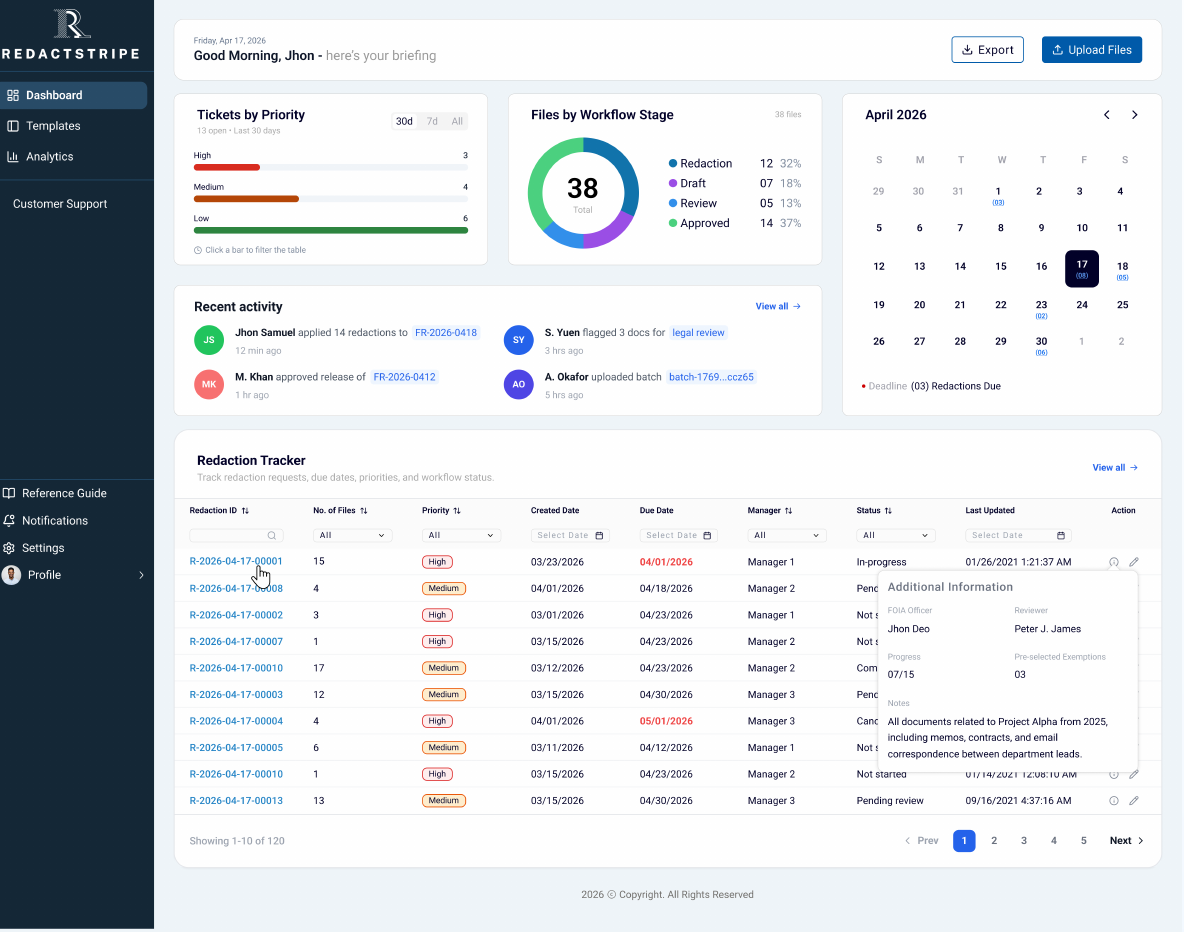
Coordinate FOIA officers, redactors, reviewers, and managers through case stages and approval responsibilities.
Apply permanent redactions and metadata sanitization, with encrypted audit records separate from the released content.
Role-based access, SSO and MFA support, and a layer manager with locking help teams control who can work on a record and how it is released.
Discuss your media types, security requirements, and review policy during a demonstration.
A proposed pilot for customer discussion. This is not a completed customer deployment.
A public-records office receives a mixed set of correspondence and attachments. Staff need to protect sensitive information while preserving the content the public is entitled to receive.
A proposed approachUse a representative document set to evaluate AI suggestions, reviewer decisions and the final release copy. The records team determines which information should be withheld under its policy.
Request a demonstration with the product team.